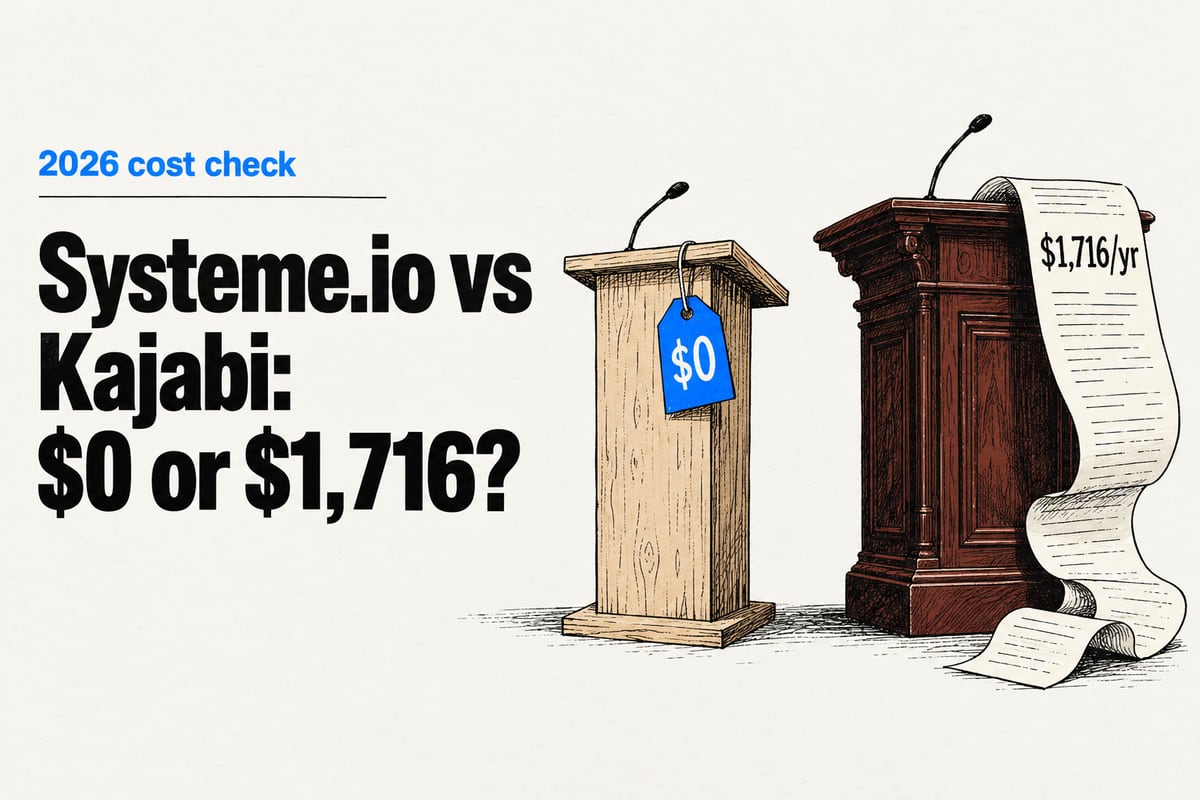
Systeme.io vs Kajabi comes down to the bill: Systeme.io costs $0 to $97 a month, while Kajabi now starts at $143 a month billed annually ($179 monthly), and its old Kickstarter plan is no longer on its pricing page. For a solo creator under 10,000 contacts, Systeme.io is the better buy, roughly $1,500 to $1,900 cheaper in year one. Kajabi earns that gap only if you need its branded app, graded quizzes, podcasts, a team of admins or a 30-day refund window.
Kajabi raised its prices on 13 January 2026, so most comparisons you will find still quote numbers that no longer exist. Every price below was checked against both vendors’ pricing pages on 14 October 2026.
We may earn a commission if you sign up through links on this page, at no extra cost to you. This does not affect our ratings. See how we test.
Start Systeme.io free, no card needed →
Systeme.io vs Kajabi: which one should you pick?
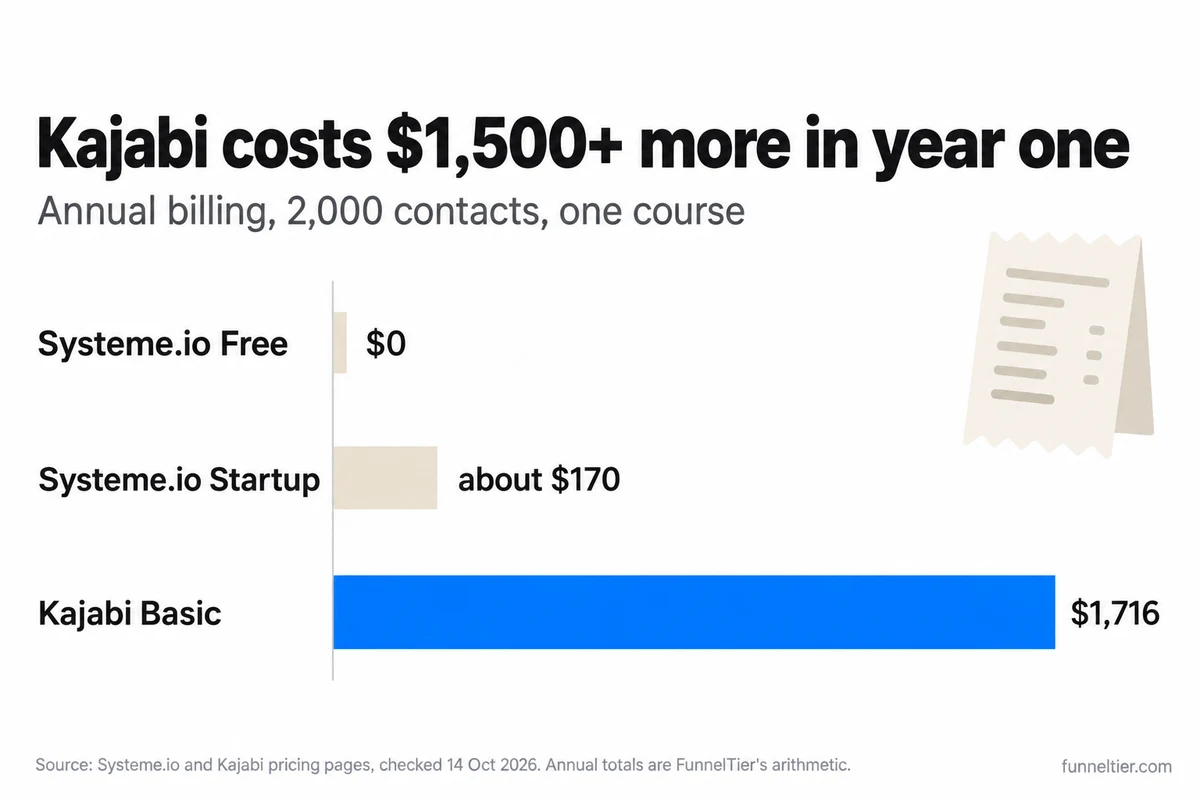
Pick by list size first, then by whether you need Kajabi’s course extras. Most solo creators don’t, and paying for them anyway costs about $1,500 a year.
| Your situation | Pick | Year one (annual billing) |
|---|---|---|
| No sales yet, testing an idea | Systeme.io Free | $0 |
| One or two courses, under 5,000 contacts | Systeme.io Startup ($17/mo) | about $170 |
| Webinar-led launches, 5,000 to 10,000 contacts | Systeme.io Webinar ($47/mo) | about $470 |
| Over 10,000 contacts, lots of funnels | Systeme.io Unlimited ($97/mo) | about $970 |
| Course brand that needs an app, graded quizzes, podcasts or admin seats | Kajabi Growth ($199/mo) or Pro ($399/mo) | $2,388 or $4,788 |
Annual totals are our arithmetic from each pricing page, checked 14 October 2026.
Pick Systeme.io if you sell one to five courses, want funnels, email and checkout in one account, and would rather keep $1,500 than pay for features you haven’t missed yet. The Free plan is a working account you can sell from, with 2,000 contacts, 1 course and 500 students, according to Systeme.io’s pricing FAQ.
Pick Kajabi if the course already is the business and your students expect a mobile app, graded tests with a pass mark, or a podcast feed next to the lessons. It also suits teams, since Growth includes 11 admin users. And if you want the option of a refund, Kajabi offers 30 days on every plan. Systeme.io offers none.
Still comparing more than two tools on a zero budget? We have also tested other free funnel builders.
Open a free Systeme.io account with 2,000 contacts →
How much do Systeme.io and Kajabi cost in 2026?
Both price mainly by contacts. The difference is the floor: Systeme.io starts at zero, Kajabi at $143 a month.
Systeme.io: $0, $17, $47 or $97 a month
| Plan | Monthly | Annual (about) | Contacts | Sales funnels | Courses |
|---|---|---|---|---|---|
| Free | $0 | $0 | 2,000 | 3 | 1 |
| Startup | $17 | $170 | 5,000 | 10 | 5 |
| Webinar | $47 | $470 | 10,000 | 50 | 20 |
| Unlimited | $97 | $970 | Unlimited | Unlimited | Unlimited |
The annual toggle says “2 months free” but prints no yearly totals, so that column is our arithmetic: ten times the monthly price. Every plan, Free included, gets unlimited emailing, unlimited file storage, the built-in affiliate program and “no transaction fees” on Stripe or PayPal. We break down every Systeme.io plan and limit in a separate guide.
Kajabi after the 13 January 2026 price rise
| Plan | Monthly | Annual, per month | Year one, annual | Contacts | Products | Admins |
|---|---|---|---|---|---|---|
| Basic | $179 | $143 | $1,716 | 2,500 | 5 | 2 |
| Growth | $249 | $199 | $2,388 | 25,000 | 50 | 11 |
| Pro | $499 | $399 | $4,788 | 100,000 | Unlimited | 26 |
Basic was $149 a month before the rise, according to third-party records; Kajabi’s own page now shows only the new prices. Existing customers moved to them on their first billing date on or after 13 January 2026, unless they were on a Founder or Beta Invite plan. Kickstarter is no longer listed on Kajabi’s pricing page, so Basic is the entry point for new accounts. There is no free plan.
The product cap is the limit people miss. Each course, coaching program, podcast and newsletter counts as one product, all your downloads together count as one, and communities don’t count. Two courses, a coaching offer, a podcast and a newsletter fill Basic completely.
Funnels, landing pages and marketing emails are unlimited on all three Kajabi plans. If ClickFunnels is also on your list, we ran the same numbers on how ClickFunnels compares with Kajabi.
Why other comparisons show $55, $89 or $119
"Kajabi starts at $55 or $89 a month"
Kickstarter is no longer listed. Basic is $143 billed annually, $179 monthly.
"Kajabi Basic is $119 a month"
That was a pre-2026 annual price shown as monthly.
"Systeme.io Startup costs $27"
It is $17 a month on today's pricing page.
"Systeme.io needs a paid plan for a custom domain"
The Free plan includes 1 custom domain.
Data-table sites tend to show Kajabi’s old annual prices labelled as monthly, and one long-read still credits Systeme.io with a “30-day free trial” it has never had. A quick check: if a page quotes Kajabi below $143, its Systeme.io vs Kajabi numbers were written before January.
What will you pay in year one at 500, 2,000 or 10,000 contacts?
Here is the cheapest plan on Systeme.io and on Kajabi that covers your list, on annual billing. No ranking page we checked runs Systeme.io vs Kajabi this way with 2026 prices, and the gap is wider than the monthly sticker suggests.
| Your list | Systeme.io | Kajabi | You keep with Systeme.io |
|---|---|---|---|
| 500 contacts, 1 course | $0 (Free) or about $170 (Startup) | $1,716 (Basic) | about $1,546 to $1,716 |
| 2,000 contacts | $0 (Free, at the cap) or about $170 (Startup) | $1,716 (Basic) | about $1,546 to $1,716 |
| 10,000 contacts | about $470 (Webinar) | $2,388 (Growth; Basic stops at 2,500) | about $1,918 |
| Just over 10,000 | about $970 (Unlimited) | $2,388 (Growth) | about $1,418 |
Our arithmetic from each vendor’s pricing page, checked 14 October 2026.
On monthly billing the gap grows. Systeme.io comes to $0, $204 or $564 for the year at those first three sizes; Kajabi comes to $2,148, $2,148 and $2,988. Paying Kajabi Basic monthly costs $432 more a year than paying annually.
Why pay $170 for Startup at 500 contacts when Free covers you? Free gives you 1 automation rule and 1 email campaign, which is enough for a lead magnet and thin for a launch. It also stops taking payments after $10,000 in lifetime sales. A $200 course reaches that after 50 sales.
At 2,000 contacts, the honest comparison is Systeme.io Startup at about $170 against Kajabi Basic at $1,716. For the same course and the same list, Kajabi costs roughly ten times as much.
The add-ons that widen the gap
The table above is the floor. These are the costs that push Kajabi’s number higher:
- Branded app: $199 a month on Basic and Growth, included on Pro. Growth plus the app comes to $4,776 a year by our arithmetic, $12 less than Pro on annual billing ($4,788). If you want the app, price Pro.
- Third-party payment fee: keep Stripe on Basic and Kajabi adds 2% on top of your processor’s own fee (1% on Growth, 0.5% on Pro). On $20,000 of course sales, that is $400 extra. PayPal and Kajabi Payments are exempt, and the fee only applies where Kajabi Payments is available. Kajabi Payments itself charges 2.9% + $0.30 per US card sale on Basic.
- Extra contacts: blocks of 25,000 for $125 a month, at any size.
- AI credits: 0 on Basic, 500 on Growth, 1,000 on Pro.
On the Systeme.io side, the platform fee is 0% on every plan. Watch two things instead. Free accounts are capped at $10,000 in lifetime sales (affiliate commissions don’t count). When you reach it you get an email and 3 days to upgrade, after which your payment pages stop accepting new sales. Nothing is charged automatically.
Start on Systeme.io’s free plan, upgrade at $17 when you need to →
Is Kajabi better than Systeme.io for courses?
In a few specific ways, yes. Courses are where Kajabi earns most of its price against Systeme.io, so it deserves a fair hearing before you write it off.
Course builder, drip and quizzes
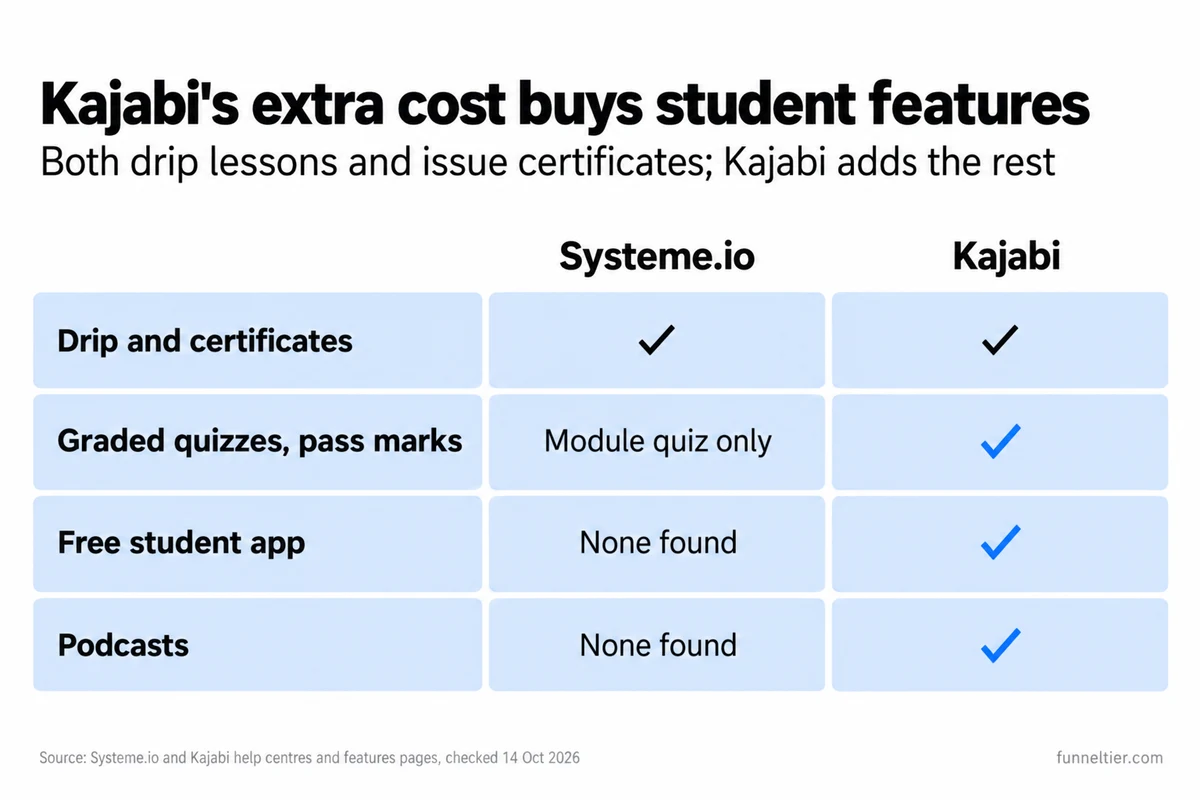
Both tools drip content and issue certificates. Systeme.io offers four access types (drip, full, partial, and partial with drip), course bundles, and a completion certificate with your logo and signature.
The quizzes are where they split. Systeme.io quizzes are built per module with the correct answers marked, and a quiz only opens once every lesson in that module is marked complete. Kajabi quizzes can be graded or ungraded, take multiple choice, checkboxes, short answers and file uploads, auto-grade the first two types, and can require a passing grade before the next module opens.
Kajabi certificates work too, but the automated route (a tag fired when the final lesson is completed) needs Growth or Pro. If students must pass a test to earn a credential, Kajabi’s quiz tool is the better one. If quizzes are a knowledge check, Systeme.io’s is enough.
Community
Systeme.io includes online communities, free or paid, and builds memberships through its course and community system. The pricing page does not currently show how many communities each plan gets. Kajabi gives 1 community on Basic and Growth and 3 on Pro, and communities don’t count against your product limit.
Mobile app
Kajabi has a free student app for iOS and Android. One caveat from Kajabi’s own help page: “Changes have been made to the interactive features of the Kajabi iOS mobile app that affect the Community, post comments, and assessments.” A branded app under your own name is included on Pro or costs $199 a month on Basic and Growth.
We found no dedicated student app for Systeme.io, so students take your course in a mobile browser. For short lessons that is fine. For a course people binge on their commute, it is a real gap.
Podcasts, coaching and cohorts
Kajabi treats courses (evergreen or cohort), coaching, podcasts, newsletters and downloads as products you can sell. Cohort courses are one of its new-plan features. On Systeme.io, the booking calendar with deposits and payments is the closest match to a coaching product, and we found no podcast hosting.
Count how many of these you would use in the next 12 months: graded quizzes with a pass mark, a student app, podcasts, cohorts. If the answer is zero or one, the Kajabi premium buys you very little, and Systeme.io vs Kajabi becomes a pure price question.
How do funnels, email and selling compare?
Here the gap mostly runs the other way. Systeme.io gives you more selling tools for less money, with tighter caps on funnels.
| Systeme.io | Kajabi | |
|---|---|---|
| Marketing emails | Unlimited, every plan | Unlimited, every plan |
| Sales funnels | 3 / 10 / 50 / unlimited | Unlimited, every plan |
| Affiliate program for your products | Every plan, Free included | Growth and Pro only |
| Platform fee on sales | 0% | 0% on Kajabi Payments and PayPal; 2% / 1% / 0.5% on other processors |
Checked 14 October 2026.
The funnel cap only matters if you build many small funnels, say one per lead magnet. Startup’s 10 funnels cover most solo creators. Kajabi’s unlimited funnels are a real advantage if you run dozens.
The affiliate program is the bigger split. On Systeme.io you can recruit affiliates for your own course from the Free plan. On Kajabi you need Growth, which is $2,388 a year on annual billing. Evergreen webinars come with Systeme.io’s Webinar and Unlimited plans, though we found no live webinar tool.
Systeme.io also lists SMS, CRM pipelines, physical products and a creator store. Kajabi’s edge is team access: 2, 11 or 26 admin users depending on plan, plus an API on its new plans. If you are weighing funnel-first tools more broadly, our ClickFunnels vs Systeme.io comparison covers the funnel builder in more depth.
Which has the better trial and refund terms?
Kajabi does. Systeme.io makes up for it with a free plan that never ends, but once you pay, you can’t get the money back.
Systeme.io’s terms are blunt: “Please note that our subscription plans are not refundable.” If you cancel, you keep your plan until the next billing date, then the account drops back to Free. Your work stays, but the money is gone.
So test Systeme.io the cheap way. Build on Free until you hit a cap, then pay monthly for a month or two before you switch to annual. Annual only saves two months, about $34 a year on Startup and $94 on Webinar (our arithmetic), which isn’t worth locking in before you know the tool fits. If you want a walkthrough, here is how to set up Systeme.io’s free plan step by step.
Kajabi’s 14 days are tight for building a course and getting feedback from students, but the 30-day guarantee gives you a second window after the first payment.
Test Systeme.io on the free plan before you pay a cent →
Where does each one fall short?
These are the limits that would make us pick Kajabi over Systeme.io, or the other way round.
Where Systeme.io falls short:
- Free is tight: 1 automation rule, 1 email campaign, 1 course and 500 students per the FAQ.
- Paid plans are not refundable, and they upgrade automatically if you stay over a limit for 3 days after the notice.
- We found no podcasts, no live webinars and no dedicated student app.
- Contact export is a CSV emailed to you and available to download for only 3 days. We found no documented export for funnels, pages or courses.
Where Kajabi falls short:
- No free plan, only a 14-day trial.
- Basic stops at 2,500 contacts and 5 products.
- No affiliate program on Basic.
- A 2% fee on Basic if you keep a third-party processor such as Stripe.
- The branded app costs $199 a month below Pro, and Basic gets 0 AI credits.
- The free iOS app has had its community, comment and assessment features changed.
For the longer list of Systeme.io’s strengths and weaknesses, read our full Systeme.io review.
How do you switch from Kajabi to Systeme.io?
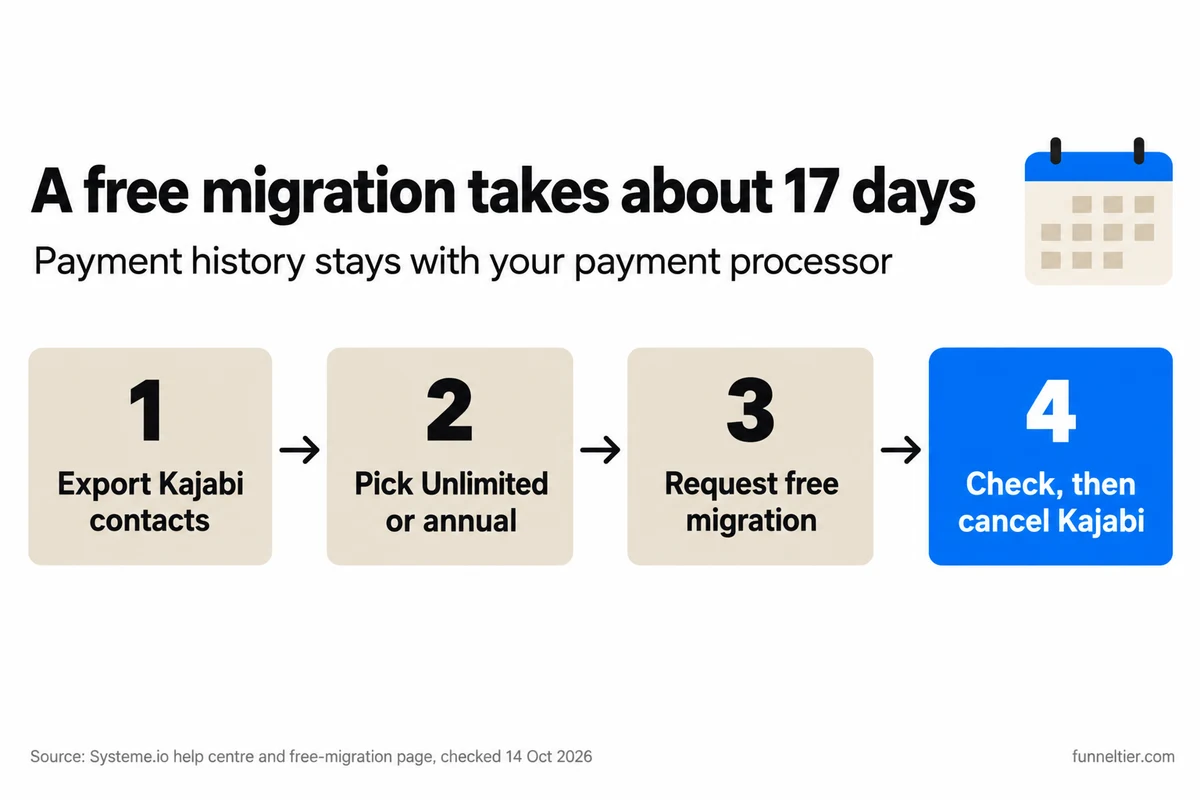
Systeme.io names Kajabi on its free-migration page. The migration is included at no extra cost with the Unlimited monthly plan ($97) or any annual plan.
That makes Startup on annual billing, about $170 (our arithmetic), the cheapest way to get a free migration, as long as your list fits in 5,000 contacts and 5 courses. Remember that the annual payment is not refundable.
What doesn’t move: payment and transaction history stay with your payment processor. Whether active subscriptions and payment plans carry over is not documented, so don’t assume they do.
Plan for 17 days. Systeme.io’s help centre says “On average, a migration takes 17 days.” Its marketing page is more optimistic, at 2 to 5 business days for simple moves and 1 to 2 weeks for larger ones. Keep Kajabi running until everything is checked, and do it in this order: export your Kajabi contacts first, pick the Unlimited or an annual plan, request the migration, then check the result before you cancel Kajabi. Don’t edit either account while the move is running.
Open Systeme.io and request the free Kajabi migration →
Frequently asked questions
Is Systeme.io better than Kajabi?
For most solo creators under 10,000 contacts, yes, because Systeme.io does the core job for about $1,500 to $1,900 less in year one. Kajabi is better for course brands that will use graded quizzes, a student or branded app, podcasts or several admin seats.
How much does Kajabi cost in 2026?
Basic is $179, Growth $249 and Pro $499 a month on monthly billing, or $143, $199 and $399 a month billed annually. Basic was $149 a month before the price rise on 13 January 2026, according to third-party records.
What happened to Kajabi's Kickstarter plan?
It is no longer listed on Kajabi's pricing page, which shows only Basic, Growth and Pro. Third-party records say existing Kickstarter accounts kept their price, but new accounts start at Basic.
Does Kajabi have a free plan?
No. Kajabi offers a 14-day trial and a 30-day money-back guarantee on every plan. If you enter a card for the trial, it is charged the day the trial ends.
Is Systeme.io really free, and what's the catch?
Yes, and it never expires or needs a card. The catches are the caps: 2,000 contacts, 3 sales funnels, 1 course, 500 students per the FAQ, 1 automation rule, 1 email campaign and $10,000 in lifetime sales.
Can I move my courses from Kajabi to Systeme.io?
Yes. Systeme.io names Kajabi on its free-migration page, and the move is included at no extra cost with the Unlimited monthly plan ($97) or any annual plan. Its help centre puts the average at 17 days. Payment history stays with your payment processor.
Does Kajabi charge transaction fees?
Kajabi takes no revenue share. Kajabi Payments charges card fees (2.9% + $0.30 per US sale on Basic), and other processors carry an extra 2%, 1% or 0.5% depending on plan. PayPal is exempt.
Does Systeme.io have a mobile app for students?
We found no dedicated student app, so students use a mobile browser. Kajabi has a free student app for iOS and Android, and a branded app on Pro or for $199 a month on the lower plans.
Which is cheaper for 10,000 contacts?
Systeme.io's Webinar plan at about $470 a year on annual billing, against $2,388 for Kajabi Growth. Kajabi Basic tops out at 2,500 contacts, so it doesn't cover a list that size.
Can I get a refund from Systeme.io or Kajabi?
Systeme.io's paid subscriptions are not refundable; cancelling drops you to Free at the next billing date. Kajabi offers a 30-day money-back guarantee on every plan.
The bottom line
Cost settles this for most people. A solo course creator under 10,000 contacts who picks Systeme.io keeps roughly $1,500 to $1,900 in year one, and gets funnels, unlimited email, an affiliate program and 0% platform fees on every plan.
Kajabi is the better buy for an established course brand that will actually use graded quizzes, an app, podcasts and admin seats, and wants a refund window. If you can’t name which of those you would use this year, you don’t need them yet. Start free, and move up only when a cap gets in your way.
Build your first course on Systeme.io for $0 →
Ready to build your first funnel?
Start with ClickFunnels — the tool we test and recommend — and have a working funnel published today.
Start the 14-day free trial →