Is selling PLR profitable? It can be, but not the way PLR sellers pitch it: a $27 sale keeps about $25.92 on your own funnel after US card fees (about $23.99 on Etsy), yet profit only starts once the fixed costs (the licence, the software, any ad test) are back. On Systeme.io’s free plan with a $50 PLR pack and a $300 ad test (our assumptions), that takes 14 sales at $27, and unedited PLR rarely gets there because buyers can find the same pack elsewhere. No independent data on PLR earnings exists, so this post shows the arithmetic instead of anyone’s income, with fees and prices checked 20 October 2026.
We may earn a commission if you sign up through links on this page, at no extra cost to you. This does not affect our ratings. See how we test.
See what a funnel-with-product pack includes: free PLR Funnels masterclass →
Is selling PLR profitable? The short answer
Per-sale margin is high, but profit isn’t automatic. Those are two different numbers, and almost every page ranking for this question blurs them.
Selling PLR carries two kinds of cost:
- Per-sale costs. Card processing, or Etsy’s fees. They only happen when you sell, and at the prices below they take about 4% to 12% of each sale.
- Fixed costs. The PLR licence, the software, any ad test, and your own time. You pay them before the first sale, whether or not anything sells.
The vendors who quote “80–100% margins” are describing the first kind and skipping the second. A product that keeps 96% of every sale still loses money if it sells ten copies against $641 of setup costs. PLR can still turn a profit, so long as you do the sums before you buy anything.
This post is the economics only. For the process (licence checks, rework, channels, funnel setup), read how to sell PLR products, step by step.
How much do you keep from each PLR sale?
Most of it. Here’s what one sale nets on two channels at three example prices, after per-sale fees and nothing else:
| Price (our example) | Own funnel, Stripe US card | Etsy, US |
|---|---|---|
| $17 | $16.21 (95%) | $14.94 (88%) |
| $27 | $25.92 (96%) | $23.99 (89%) |
| $47 | $45.34 (96%) | $42.09 (90%) |
The $17, $27 and $47 prices are our example figures, not market data. Own-funnel figures use Stripe’s US pricing of 2.9% + 30¢ per domestic card charge (international cards add 1.5%, currency conversion another 1%). Etsy figures use its Fees & Payments Policy: a 6.5% transaction fee, 3% + $0.25 payment processing in the US, and a $0.20 listing fee that we count once per sale (our modelling choice, not Etsy’s rule). Etsy can also add an Offsite Ads fee on attributed sales; it isn’t included. No refunds, taxes or VAT in any figure. Checked 20 October 2026.
On your own funnel, the software takes nothing per sale. ClickFunnels’ pricing FAQ answers the transaction-fee question with “No. You’ll keep every penny you make.” Systeme.io advertises “0% transaction fees on all plans”. The card processor still charges, and that’s the whole gap between $27 and $25.92. We modelled Stripe only. PayPal’s fees weren’t checked.
So the honest PLR profit margin is 88–96% per sale. Post Affiliate Pro quotes “60–80%” margins and ResellReady “80–100%”, and neither shows a fee. ResellReady’s top end can’t happen on a real card sale, because a processing fee always comes off. Post Affiliate Pro’s range sits below ours without saying which costs it subtracted.
Neither gives you the number that decides profit: how many sales it takes to cover the fixed costs.
What does selling PLR cost before the first profit?
Four things, and only one of them is the PLR itself.
The PLR licence
Loose PLR is cheap. IDPLR, one of the large PLR stores, lists single products at $6.90 and $10.00 and claims more than 12,000 packages. Bundles cost more, so our example pack is $50. That’s an assumption, not a quote.
The licence matters more than the price. Some PLR licences set a minimum resale price or rule out giving the product away, which can cap what you charge or stop you using it as a lead magnet. The how-to guide linked above has the licence checklist.
Rework time
PLR that sells has usually been changed: a new angle, a new title, your own examples, sometimes a new format. That’s hours, not minutes.
Put your own numbers in. If the rework takes 15 hours and you value your time at $20 an hour (both our assumptions), that’s $300 of unpaid work, about the same as setup B’s whole cash outlay below. The tables leave time out. Your decision shouldn’t.
The platform
There are three common routes, and each one charges you differently:
- Systeme.io Free: $0, no credit card required, and the plan never expires. It covers 2,000 contacts, 3 sales funnels and 1 custom domain, which is enough to test one PLR product. Paid plans start at $17/mo. See Systeme.io’s free plan limits and selling digital products on Systeme.io.
- ClickFunnels Launch: $97/mo, or $970/yr billed annually, after a 14-day trial that needs a card at signup. The done-for-you pack covered further down only runs on ClickFunnels, so start the trial when you’re ready to build, not on the day you first read about it. Every ClickFunnels plan is broken down separately.
- Etsy: no monthly fee. You pay per listing and per sale, as in the table above.
Traffic
No PLR pack includes buyers. You either build an audience over time (free in cash, expensive in hours) or pay for a test. Our example is a $300 ad budget: a fixed amount you’re prepared to lose while you find out whether the offer converts at all.
Add those up and you get four realistic starting points, one of them with two billing options:
| Setup | Working | Fixed cost |
|---|---|---|
| A. Systeme.io Free + $50 pack, no ads (first 90 days) | $0 + $50 | $50 |
| B. Systeme.io Free + $50 pack + $300 ad test (first 90 days) | $0 + $50 + $300 | $350 |
| C. ClickFunnels Launch + $50 pack + $300 ad test (first 90 days) | $291 + $50 + $300 | $641 |
| D. PLR Funnels at $797 (2023 launch price, placeholder) + Launch monthly, year one | $797 + 12 × $97 | $1,961 |
| D2. Same, Launch billed annually | $797 + $970 | $1,767 |
$291 is three Launch charges in the first 90 days: the trial covers days 1–14, then billing lands around days 14, 44 and 74. Setups D and D2 use $797, the pack’s 2023 launch price (Russell Brunson, Marketing Secrets podcast, 4 August 2023), as a placeholder only, because no current price is published. The $50 pack and $300 ad test are our example figures.
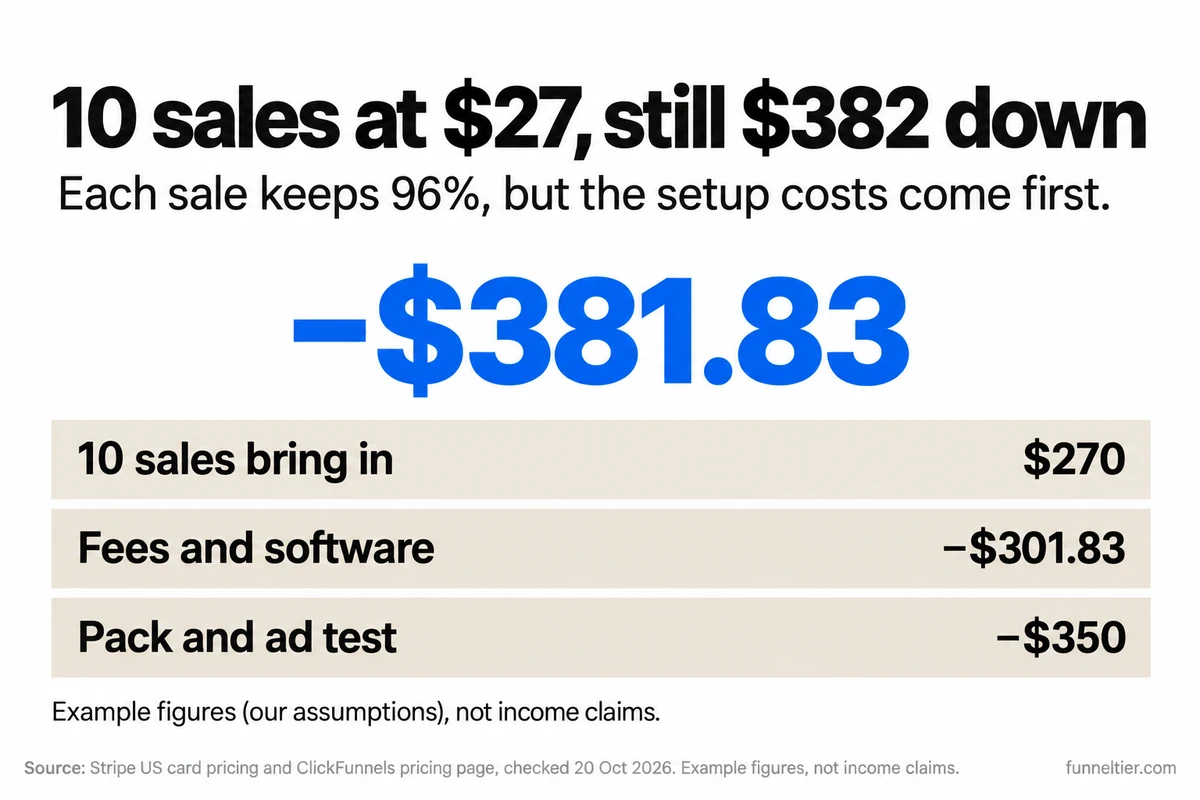
Now the margin problem in one number. Take setup C and sell ten copies at $27. Each sale keeps 96%. After ten sales you’ve taken in $270, then paid $10.83 in card fees, three ClickFunnels bills ($291), and the pack plus the ad test ($350). You’re $381.83 down, with a “96% margin” on every sale.
How many PLR sales does it take to break even?
Divide the fixed cost by what each sale keeps, then round up. This is the table every “is selling PLR profitable” page we read skips.
| Setup | Fixed cost | at $17 | at $27 | at $47 |
|---|---|---|---|---|
| A. Systeme.io Free, no ads | $50 | 4 | 2 | 2 |
| B. Systeme.io Free + ad test | $350 | 22 | 14 | 8 |
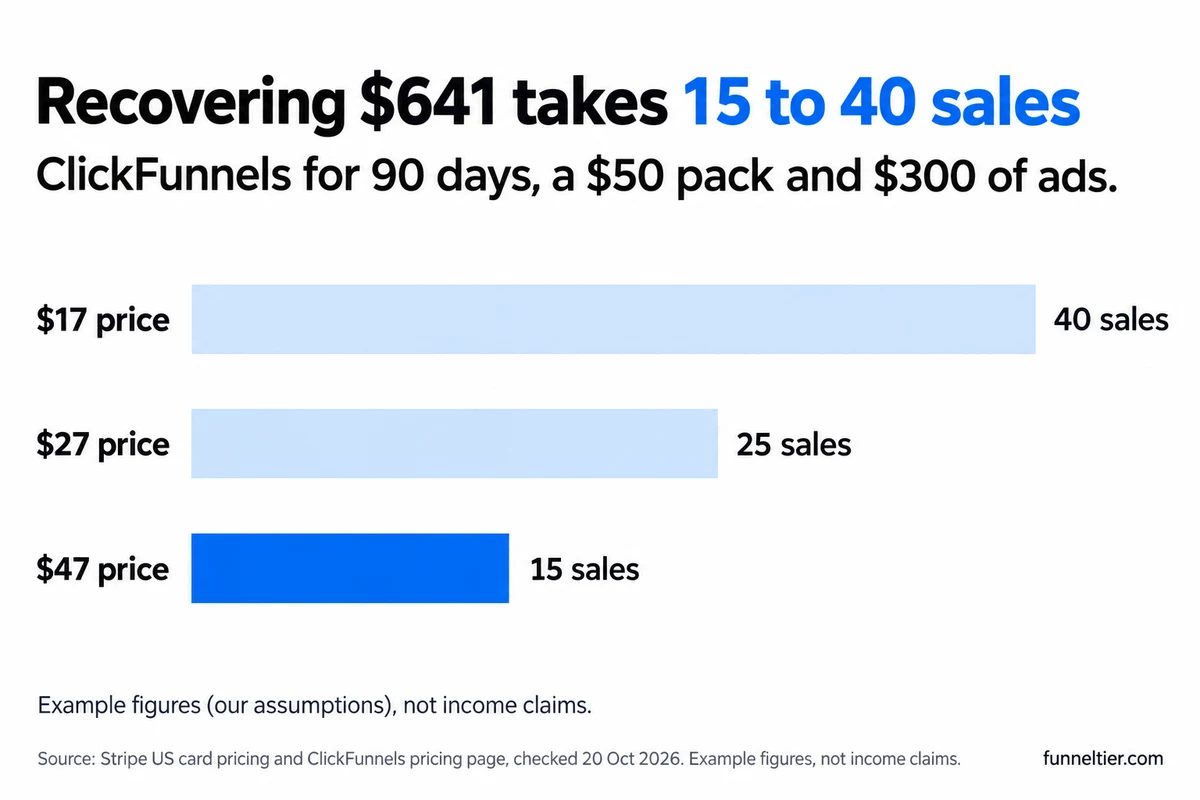
| C. ClickFunnels Launch + ad test | $641 | 40 | 25 | 15 |
| D. PLR Funnels + Launch monthly | $1,961 | 121 | 76 | 44 |
| D2. PLR Funnels + Launch annual | $1,767 | 110 | 69 | 39 |
Sales needed = fixed cost ÷ own-funnel net per sale ($16.21, $25.92 or $45.34), rounded up. Checked 20 October 2026.
Setup B is the cheapest real test: free software, a $50 pack, $300 of ads. At $27 you need 14 sales to get back to zero. At $47 you need 8.
Setup C swaps the free plan for ClickFunnels Launch, which adds $291 over 90 days and lifts the $27 break-even from 14 sales to 25. The software is the only difference between those two rows.
Setup D is the pack route for a full year, at the 2023 price. That’s 76 sales at $27. Our PLR Funnels review says “about 73” for the same $1,961, and both are right: 73 is before payment fees (1,961 ÷ 27 = 72.6), 76 is after Stripe takes its cut.
Sales are only half the sum. To get them you need visitors:
Visitors needed = sales needed ÷ visitor-to-buyer rate.
For setup C at $27, that’s 25 sales:
These rates are assumptions to show how sensitive the answer is, not benchmarks. You’ll see 6.6% quoted around the web. That’s the median in Unbounce’s 2024 Conversion Benchmark Report, and it counts form fills and clicks, not purchases, so don’t use it as a sales rate. Your first 90 days exist to find your real ones.
Run the sums with the real price: register for the free PLR Funnels masterclass →
Why doesn’t most unedited PLR sell?
Because the same pack is for sale everywhere, and the people most likely to buy it from you are the people it was already marketed to.
Your buyers may already own it. A PLR pack is sold to many sellers in one niche, usually through the same lists and groups. Your likeliest customers sit in that niche too, and some will have bought the original.
Identical products compete on price. If ten stores sell the same ebook, the cheapest one wins the comparison. IDPLR alone lists single products at $6.90 and $10.00 and says it has “200 free products”. Licence price floors exist for exactly this reason, and they only work while everyone respects them.
Search won’t send traffic to copied text. Google’s spam policies list, as abusive scraping, “Republishing content from other sites without adding any original content or value, or even citing the original source”, plus copying content and modifying it “only slightly (for example, by substituting synonyms or using automated techniques)”. Its duplicate-content guidance says Google “will decide which pages (if any) are duplicates, based on similarity of content” and shows one version. That isn’t an automatic penalty. It just means the hundredth copy of a sales page has little chance of being the one Google picks.
Platforms have their own rules. Gumroad doesn’t allow PLR resale and Etsy wants your own design; which platforms allow PLR quotes each rule.
What changes the sums is rework that changes the angle and the format, not the synonyms: a niche-specific title, your own examples, a workbook instead of an ebook. That’s the point where your product stops competing with every other copy, and the break-even table starts to look reachable.
What do PLR “success stories” actually prove?
Less than they seem. Every “result” we found in this search was published by someone selling PLR, PLR store software or affiliate tools. None shows a method, a date or a cost. Here’s what the main claims show, including the one official result tied to PLR Funnels:
"80–100% margins" (ResellReady)
A per-sale margin before the pack, software and ads. Real sales keep 88–96% after fees.
"Six figures in 2 years" (ResellReady)
An unsourced first-name example. No method, no dates, no costs.
"$50 buy, $97 sell" and $14,455 from 150 buyers (Post Affiliate Pro)
A hypothetical with no ad cost, and its own sum is off: 150 × $97 = $14,550.
"Two Comma Club winner, 1,200 new users" (ClickFunnels blog, April 2026)
ClickFunnels' revenue from selling the pack, not buyers' resale income.
Read the last row twice. ClickFunnels’ blog says the pack became a Two Comma Club winner, “meaning it generated over $1 million in sales”, and “brought over 1,200 new users into ClickFunnels”. That’s money ClickFunnels made selling PLR. It says nothing about what buyers earned reselling it.
The pack’s own page is clear on that point. Its earnings disclaimer reads: “We make no claims or representation that by using ClickFunnels you will earn money or make your money back.” And: “These results are not typical and we make no earnings or return on investment claims.” The page shows no income testimonials at all.
The only non-vendor voices we found sit on a Warrior Forum thread that’s about 13 years old. One line from it still holds: “The people making money off PLR already have an audience to sell it to.”
So no independent data on PLR sellers’ earnings exists: we found no success rate, failure rate or typical time to first sale. Anyone quoting one is guessing or selling something, which is why this post answers “is selling PLR profitable?” with a formula instead of a figure.
What does a realistic first 90 days look like?
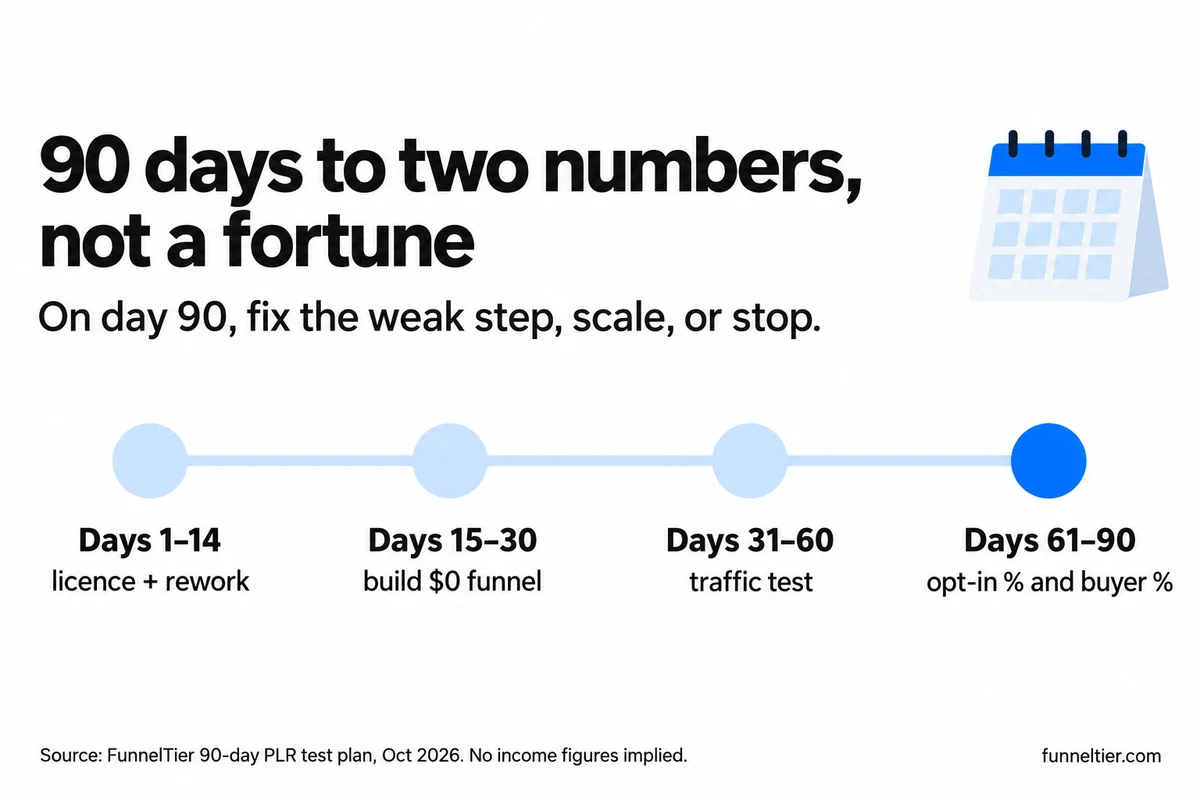
Treat it as a test rather than an income plan. The first 90 days should produce two numbers: how many visitors opt in, and how many of those subscribers buy. Those two rates tell you whether selling PLR is profitable for you, and every later decision follows from them.
-
Days 1–14: pick one niche and read the licence
Choose a niche you can already reach (a group, a list, a following). Read the licence before you edit a word, then start the rework.
-
Days 15–30: build one funnel on a $0 plan
Opt-in page, sales page, 3–5 follow-up emails. Here's how to build a $0 funnel step by step.
-
Days 31–60: send traffic
Post where your buyers already spend time, run the fixed ad test, or both. Point everything at the opt-in page, not the sales page.
-
Days 61–90: measure two numbers
Opt-in rate (visitors who join) and opt-in-to-buyer rate (subscribers who buy).
-
Day 90: fix, scale or stop
Few opt-ins: fix the lead magnet. Opt-ins but few buyers: fix the offer or the emails. Buyers coming in: add an upsell. Nothing moving: stop. Don't buy more PLR until one funnel works.
Notice what isn’t on the list: an income target. Nobody who hasn’t seen your niche and your traffic can tell you what those 90 days will earn. You can control whether you finish day 90 knowing your two rates.
If you start on ClickFunnels instead of a free plan, know where billing lands. The trial covers days 1–14, then Launch charges $97 around days 14, 44 and 74. That’s the $291 in setup C. A card is required at signup, and the pricing page offers a 30-day money-back guarantee on the software. How the 14-day trial works covers the dates in detail.
Want the funnel pre-built? Watch the free PLR Funnels masterclass →
Is selling PLR worth it for you?
It depends less on the product than on what you bring to it.
Worth it if:
- you have, or will build, an audience in one niche;
- you’ll rework the product until it’s clearly yours;
- you start on a $0 platform and measure before you spend more.
Not worth it if:
- you plan to upload packs exactly as they arrive;
- you have no traffic plan beyond “post it and wait”;
- you expect passive income in month one.
If you’ve never built a funnel at all, learn to build one funnel first. The PLR is the easy part. If you’re still choosing software, ClickFunnels vs Systeme.io compares the two platforms in the setups above.
And if you’re in the first group, already pay for ClickFunnels and want the selling parts done for you, PLR Funnels is the pack built for that platform. The next section shows what it does and doesn’t change.
See what’s inside PLR Funnels before you spend a dollar →
Loose PLR or a funnel-with-product pack like PLR Funnels?
Loose PLR gives you a product. PLR Funnels, ClickFunnels’ own pack presented by Russell Brunson, Paul Counts and Shreya Banerjee, gives you a product with the selling parts attached. Its masterclass page lists finished products, sales letters, upsells and downsells, email sequences, ads and social media posts, advertised as 52 ready-to-launch funnels, with the line “Just change your payment link and keep 100% of the profits!”
The economic effect comes from the upsells, which don’t create buyers but do raise what each buyer is worth. Say 1 in 5 buyers (our assumption) adds a $47 upsell to a $27 front end. Average net per buyer rises from $25.92 to $34.98, and setup D ($1,961, at the 2023 placeholder price) needs 57 buyers instead of 76.
What the pack doesn’t change:
Who it suits: people already on ClickFunnels who have an audience, or an ad budget they know how to spend. For them the upsells and emails replace the slowest writing and lift revenue per buyer.
Who should skip it: anyone with no list, no traffic plan, or no wish to pay $97 a month. Start with loose PLR on Systeme.io’s free plan instead; our Systeme.io review covers what that plan can and can’t do.
Our PLR Funnels review has the full verdict, the funnel count and the year-one cost. If you’d rather compare routes first, here are other done-for-you funnel routes.
See the upsells and email sequences inside PLR Funnels: free masterclass →
Frequently asked questions
Is selling PLR profitable in 2026?
It can be. Each sale keeps about 88–96% after fees, but you first have to recover the licence, software and any ad spend, then find buyers. No independent data on PLR sellers' earnings exists, so treat any income figure you see as a sales pitch.
What is the profit margin on PLR products?
Per sale, after fees: about 95–96% on your own funnel and 88–90% on Etsy, at our example prices of $17 to $47. Vendor claims of "60–80%" or "80–100%" don't show fees and ignore fixed costs entirely.
How many sales do I need to break even selling PLR?
It depends on the setup. With our example figures, a $350 start on Systeme.io's free plan needs 14 sales at $27. PLR Funnels plus ClickFunnels Launch billed monthly, using the 2023 launch price of $797 as a placeholder, needs 76 sales at $27 in year one.
Can you make money with PLR without an audience?
It's hard. Even a Warrior Forum thread from about 13 years ago landed on "The people making money off PLR already have an audience to sell it to." Budget for a traffic test, or build a small list before you buy more PLR.
Can you sell PLR as-is and still make money?
Rarely. Other sellers have the same pack, your buyers may already own it, and Google shows one version among near-identical pages. Platform rules add another limit; which platforms allow PLR covers them.
Is the PLR market saturated?
For unedited packs, yes. Forum posters said so over a decade ago and PLR stores still say it in 2026. A reworked, niche-specific product competes on its own merits instead of on price.
How long does it take to make your first PLR sale?
No reliable data exists, so anyone giving a number is guessing. Plan 90 days to learn your opt-in rate and your opt-in-to-buyer rate, then decide.
Is PLR passive income?
Not at the start. Rework, traffic and customer emails keep needing time, and even the PLR Funnels page says it makes "no earnings or return on investment claims."
Is PLR Funnels more profitable than buying cheap PLR packs?
It can raise revenue per buyer through its built-in upsells, but it needs ClickFunnels from $97 a month and its current price isn't published. It only pays off if you already have an audience. Our PLR Funnels review has the full breakdown.
Is selling PLR on Etsy profitable?
Etsy's fees take about $3 of a $27 sale, so the margin holds up. Whether Etsy accepts your product at all is the bigger question, covered in how to sell PLR products.
The bottom line
So, is selling PLR profitable? Per sale, yes: you keep 88–96% after fees. Overall, only once your sales cover the fixed costs, and that depends on traffic more than on the product.
Start at $0, rework one product, and spend 90 days finding your two numbers: opt-in rate and buyer rate. If they’re healthy and you’re already on ClickFunnels, a pack with built-in upsells and emails can raise what each buyer is worth. Check its real price before you plug it into the break-even table, because $797 is only the 2023 figure.
Check today’s PLR Funnels price in the free masterclass →
Ready to build your first funnel?
Start with ClickFunnels — the tool we test and recommend — and have a working funnel published today.
Start the 14-day free trial →